

Cango logo
Contactless bank card and smartphone on a dark desk with orange light streaks representing fast digital transactions

Cango Payment Methods: the cashier from first deposit to cashout explained

Updated: 10 November 2026

Cango payment methods: methods and limits in one table

Cango payment methods cover cards, crypto and a few alternative cashier options, and the table sums up what each one does. The Cango cashier has no NZD, so New Zealand players hold an AUD (or EUR) account, and all amounts here are in AUD.

MethodDepositWithdrawalMinimumTime
VisaYesYes (Original Credit Transfer)$15 AUD deposit, $30 AUD withdrawalDeposit instant, payout 1-3 business days after approval
MastercardYesYes (Payment Transfer)$15 AUD deposit, $30 AUD withdrawalDeposit instant, payout 1-3 business days after approval
Crypto (BTC, ETH, USDT, LTC)YesYes, to your own walletAbout $20 deposit, $30 AUD withdrawalDeposit 10-30 minutes, payout up to 1 hour after approval
Alternative cashier methodsYesDeposits only$15 AUDUsually instant

Managing a balance at Cango starts with the currency. The account currency is picked once at registration and cannot be changed, so most Kiwi players choose AUD. A New Zealand card is charged in NZD by the bank at its own rate, and the bank may add a foreign exchange fee; the casino itself takes no fee on deposits or withdrawals.

The limits matter as much as the methods. Withdrawals start at $30 AUD and stop at $8,000 AUD a week and $22,000 AUD a month, with larger sums paid in parts. Each request first sits in a pending window of up to 24 hours, then the payments team processes it within 24 hours, 7 days a week. Banners speak of instant withdrawals, but these are the real times to plan around.

For live players the cashier is the start of every session, and cango banking is simple once the order of steps is clear: deposit, play, finish the x1 turnover or the bonus wagering, verify, then withdraw. Skipping a step is what usually causes a delay, not the method itself. Tables from Evolution, Pragmatic Play Live and Ezugi run from $1 to $5,000 AUD a round, and a card deposit, usually up to $5,000 AUD per transaction, lands in time for the next round. Crypto takes a little longer to arrive but pays out fastest once a withdrawal is approved.
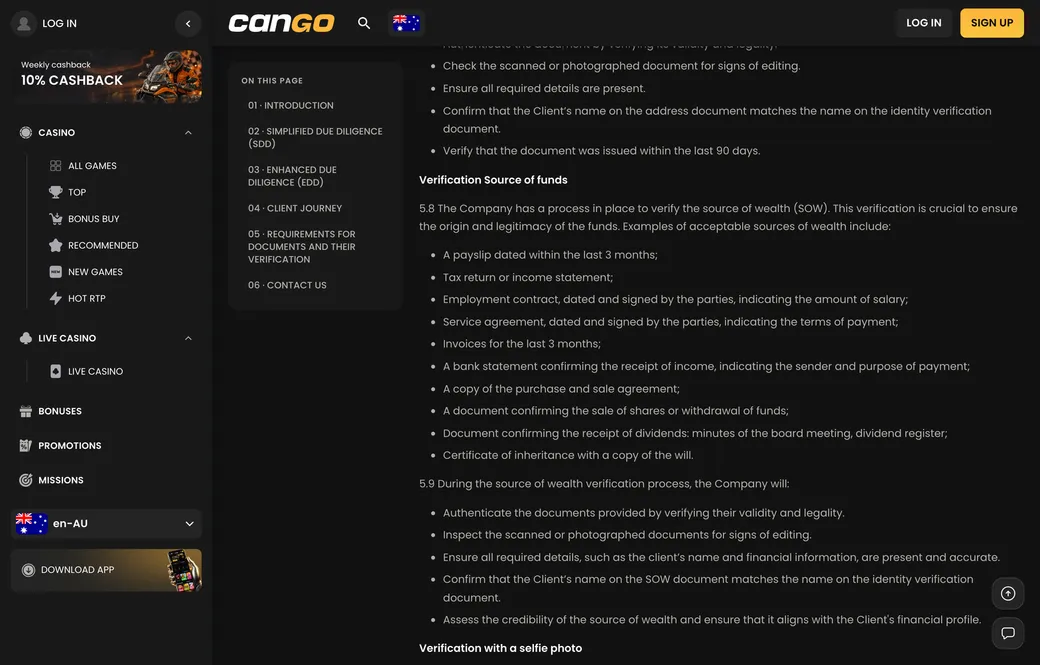

The KYC section in the profile is where the Sumsub check runs; finishing it early keeps the first cashout on the normal schedule.

Kyc 060 cango 1568x1003

Cango deposit methods: verification before cashout

Whatever deposit method you choose, verification comes before the first cashout. The KYC check runs through Sumsub inside your profile: a passport, national ID card or another photo ID, proof of address no older than 90 days and a selfie with the document. On a larger withdrawal the casino may also ask where the money came from.

The check takes up to 48 hours excluding weekends, and 24 to 48 hours is normal in practice. A repeat check can come with a large withdrawal. Do it in advance: upload the documents right after the first deposit, while you are still wagering the deposit x1 on pokies or clearing a bonus.

A short checklist helps the documents pass the first time. Photograph the ID on a flat, dark surface with all four corners visible, make sure the address on the bill or statement matches the one in your profile, and take the selfie in good light with the document held next to your face. Blurry images and cropped edges are the usual reasons for a second request.

Players who leave KYC until the first big win usually lose two days. With the account already verified, a request goes straight into the normal pending and processing queue, and a crypto payout can reach the wallet within about an hour of approval.

Cango banking: missing payment methods

A common question from New Zealand players is about local bank transfers. POLi is not among the methods in the Cango cashier, and there is no NZD option either. The practical alternatives are Visa or Mastercard, which work like any card payment, and crypto, which avoids bank conversion altogether.

Cards suit most players: the deposit lands instantly from $15 AUD, and the same card receives the payout. Crypto suits those who want quick withdrawals and already hold BTC, ETH, USDT or LTC; just pick the right network in the cashier. A typical first visit to the cashier looks like this: the player picks Visa, enters $45 AUD, adds code WP1 and confirms in the banking app, and the money and the welcome pack appear within a minute. A crypto player chooses USDT, copies the address for the network shown, sends the coins and waits 10 to 30 minutes for confirmations. Our step-by-step Cango deposit guide walks through the cashier screens for both, including where to enter code WP1 before paying.

As an illustration of the two routes: a $100 AUD card deposit lands at once and comes back by Visa in 1 to 3 business days after approval, while $100 in USDT takes 10 to 30 minutes to arrive and usually returns within about an hour of approval. Both are free on the casino side; the card route may carry a bank conversion fee, and the crypto route a network fee.

The alternative cashier methods shown in the list can fund the account, but withdrawals go back by card or crypto, so it makes sense to have one of those set up before your first cashout.

Crypto is the method that skips bank conversion: the deposit arrives in 10 to 30 minutes and an approved payout usually within about an hour.

Glowing golden cryptocurrency coins floating above a dark surface with illuminated orange circuit line patterns

Cango payment methods: whose card you can use

All payment methods must be in your own name. You can only use a card or crypto wallet that belongs to you, and a card or wallet of a friend, a family member or anyone else leads to a declined transaction and often to an account review.

The cashier records the method you deposit with, and withdrawals go back to that method whenever possible. As an illustration, a player who deposits $100 AUD by Visa and wins $400 AUD at a blackjack table gets the payout on the same Visa card; switching the payout to a partner’s card is refused. If a card expires, tell live chat before the next withdrawal so the new card can be checked.

The rule protects both sides: it stops stolen cards from being used and makes sure money returns to the person who paid it in. It applies to every account, whatever its level in the VIP Club.

The same logic covers shared devices and households. One account per person, address and device is allowed, so two people in one home should not fund each other’s balance or play from one profile. If a payment is declined for an ownership reason, live chat explains which document or card detail is missing, and the deposit can be repeated from your own card once that is sorted.

Cango deposit methods: common doubts

  • How do I claim the welcome bonus using Cango payment methods?

    To qualify for the 150% first deposit bonus, you must make a minimum deposit of $45 AUD and use the code WP1 during the transaction. This offer is available when using methods like Visa, Mastercard, or supported cryptocurrencies.

  • What are the available Cango deposit methods for players in New Zealand?

    You can fund your account using Visa, Mastercard, or cryptocurrencies such as BTC, ETH, USDT, and LTC. Deposits are typically instant for cards, while crypto payments usually take 10 to 30 minutes, and please note that POLi is not available.

  • How long does it take to process withdrawals with Cango banking?

    Withdrawals involve a pending window of up to 24 hours followed by processing of up to 24 hours, seven days a week. Once approved, crypto transfers usually arrive within 1 hour, while Visa or Mastercard payouts take 1 to 3 business days.

  • Is there a mobile app available to manage Cango banking?

    The platform functions as a progressive web app instead of a downloadable store application. iPhone users can add the site to their home screen via the share button in Safari, while Android users can install it through their browser menu.

  • What is the verification process required for Cango payment methods?

    Verification via Sumsub requires you to submit a photo ID, a proof of address under 90 days old, and a selfie holding your document. This review process usually takes up to 48 hours to complete.